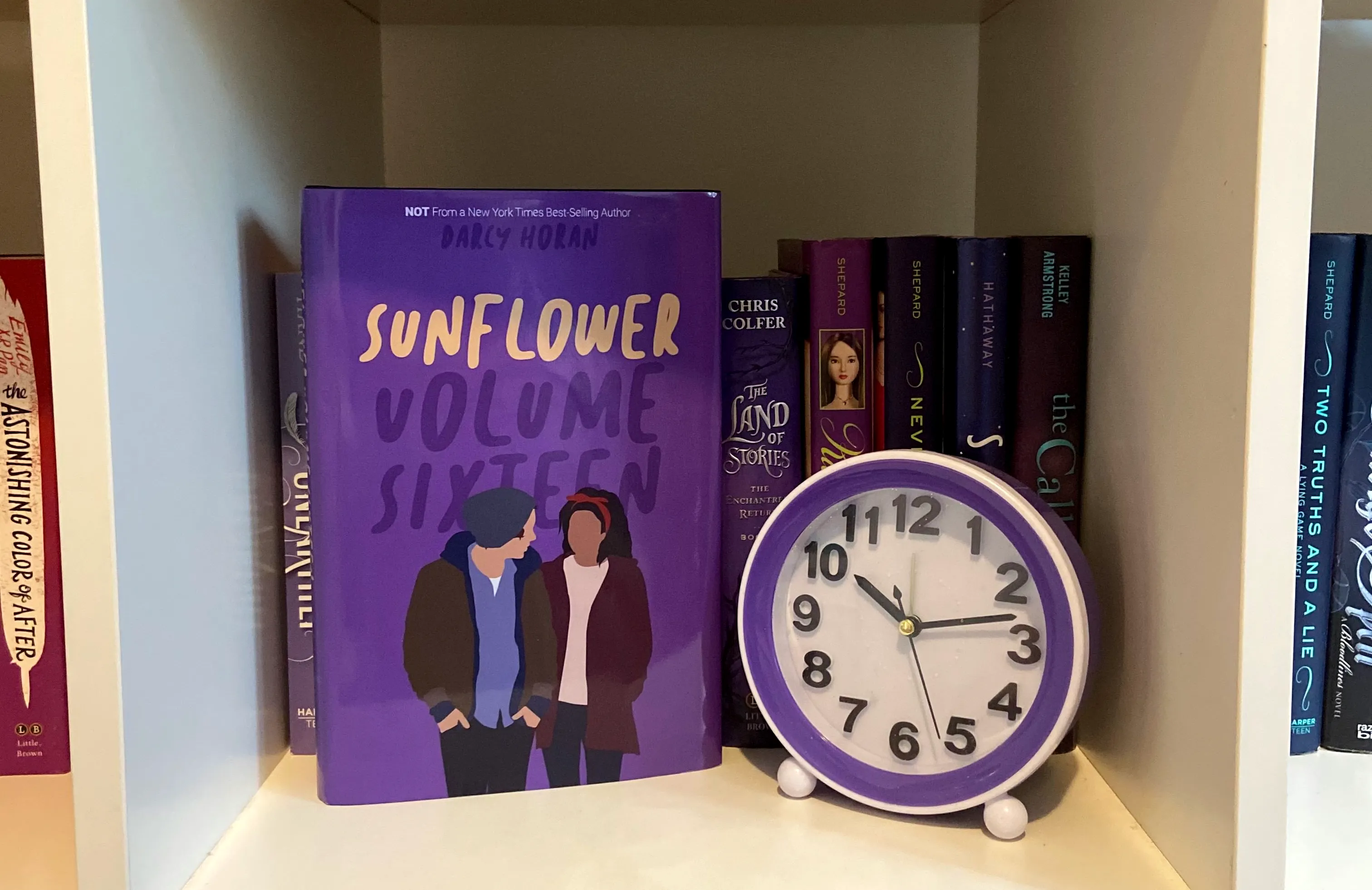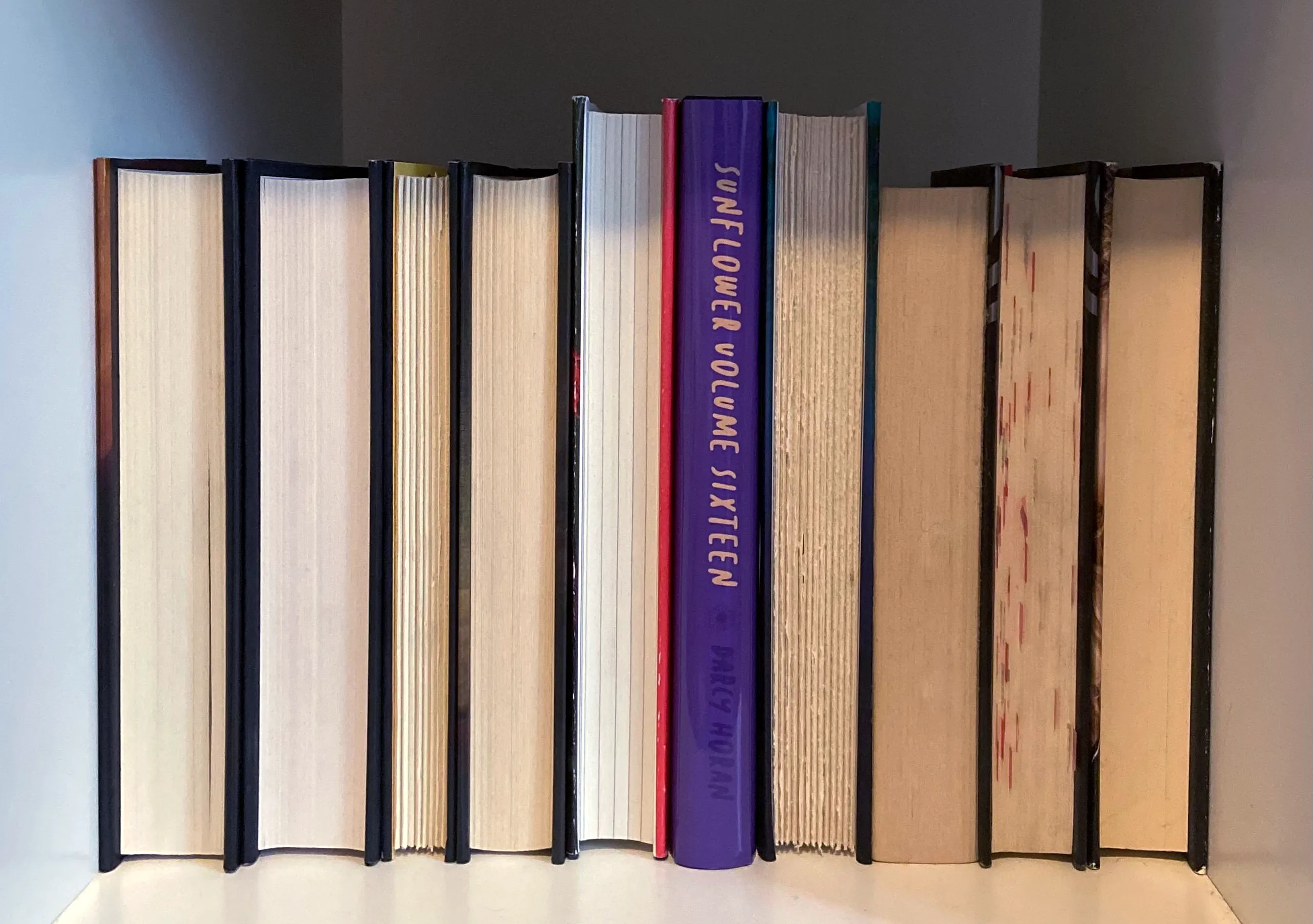
Book Present
Problem: I encountered a gap in the birthday present market for highly specific inside jokes in the form of physical gifts.
Solution: I taught myself how to use Adobe Illustrator, Adobe InDesign, and how to write over 50,000 words in under six months in order to produce a book as a joke.
In the interest of full transparency, this project was a joke.
Like many people in our demographic, my friend and I spent a great deal of our younger years consuming creative fan works based on a certain British boy band. In our adulthood, as these creative works we consumed as kids popped up again under different names in more traditional markets with some key details slightly altered, we began to discuss our history with such texts more often. As a result of these conversations, I thought it would be funny to create my own version of those stories with inside jokes and references only my friend would understand.
Originally, I planned to write maybe 20,000 words, convert to a PDF file and maybe print the first chapter on whatever paper I had on hand. However, as is frequently the case with me, I decided this was a good opportunity to learn something new. As such, the project began to grow and grow as I delved deeper into the self-publishing and book production industries. Fast forward six months later, the manuscript ended up being 54,304 words, which I then type-set using Adobe InDesign (a software I learned how to use for this project). Once I had the body copy written, edited, and set, I figured I might as well design a cover and look into having the book printed, since I was already this far into the project.
I began the process of designing a cover by first researching market trends for contemporary romance novels. It was fairly easy to deduce the market to be quite partial to illutrative, bright covers with bubbly, handwritten or display fonts. From there, I used Adobe Illustrator and a reference photo of the boy band member in question, as well as a reference photo of my friend, to create an illustrative rendering. Since this was my first experience with an illustration of this scale, I relied very heavily on the reference photo (those of you familiar with the original image will recognize it almost immediately). In a real-world scenario, this would definitely not fly, but since it was a personal project, I didn’t have to worry about things like “copyright” and “will people notice this is a near-identical copy of a photo of a famous boy band member and an international pop star he briefly dated?”
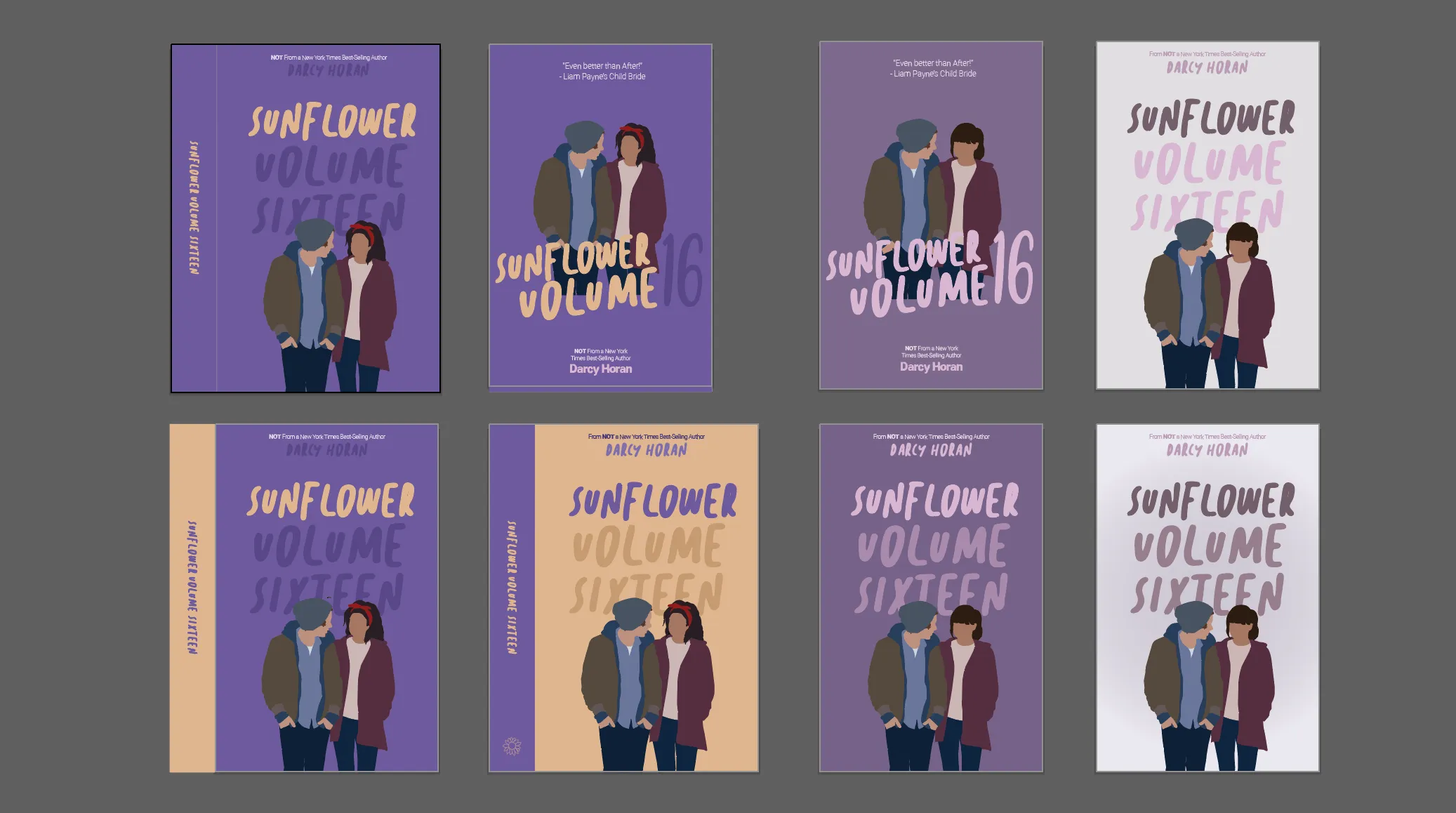
Once I had the illustration done (or two versions of the illustration, since I decided at one point I wanted the woman protagonist to look less like the international pop star and more like my friend), I began to design variations of a cover using the title and pseudonym I had given myself. Eventually, I landed on the one I liked and researched various small-scale book printing services where I could have a single copy printed. I found the website Lulu to be perfect for my needs.
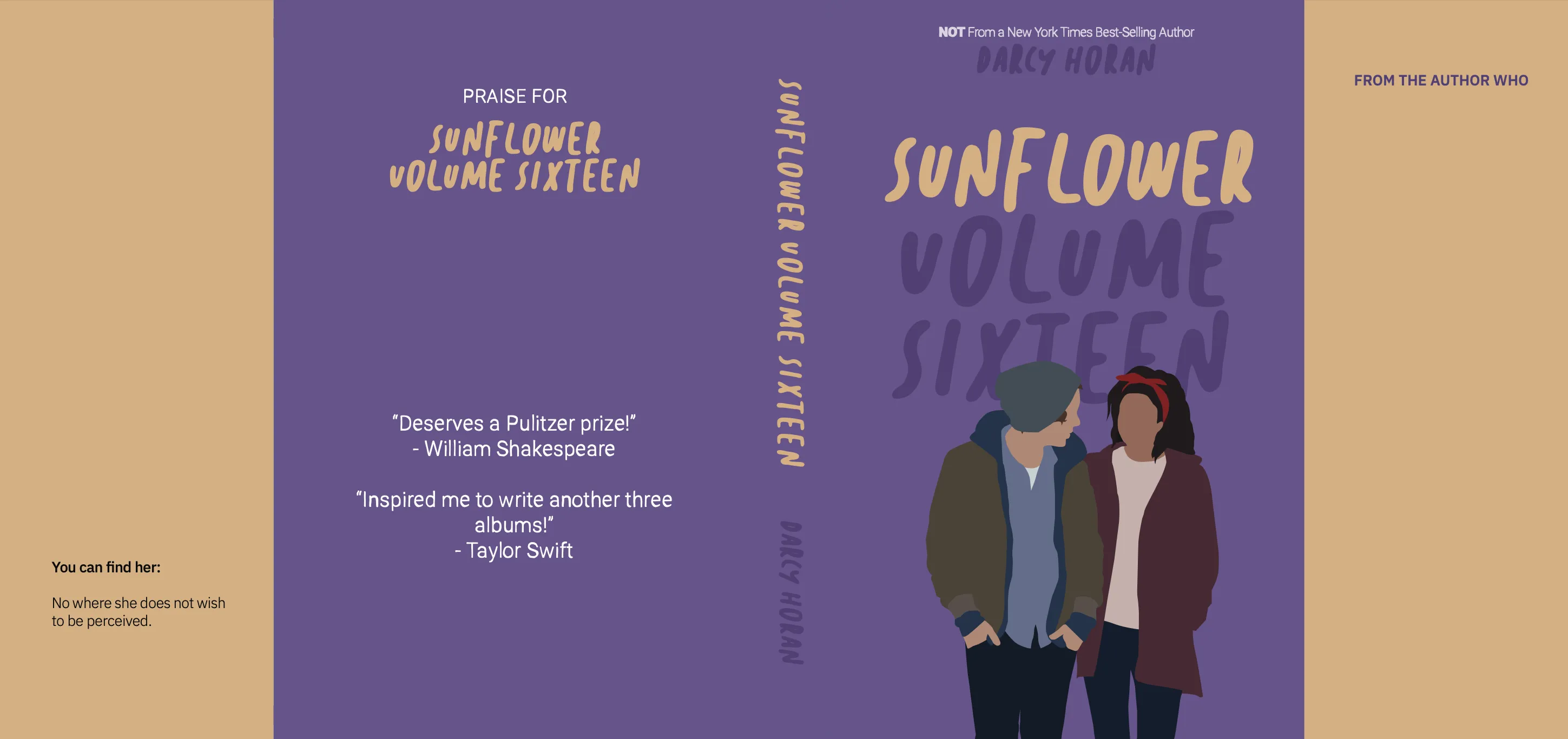
After learning more about Lulu I decided I wanted a hardcover copy, which meant designing the book jacket as well. I’ve heavily redacted the copy and images on the jacket copy, honestly because the inside-joke nature of this project means it is deeply embarrassing to display publicly. You will just have to use your imagination.
I received the physical copy in the mail less than a month later. While this project was largely a joke, holding a book that I made from scratch (excluding the binding process, though I did briefly consider doing the binding myself) was one of the coolest things basically ever. There are some things I would do differently now — the size is a little strange for a trade book, romances are usually paperback, and even if hardcover was the standard, the jacket would have been better matte instead of glossy — but overall the end product is great.
Additionally, if I were to take on a project of this scope and nature all over again, I would definitely start off with better project management. I hadn’t anticipated this gift ended up as large as it ended up (can you apply “scope creep” to a birthday present?), so I didn’t approach it with a project-orientated mindset, which left me with a lot of random todo lists and excel sheets tracking word counts and nothing else. Throughout my current enrolment in Trade and Education Publishing Overview courses at Toronto Metropolitan University, my mind has returned again and again to this project as we discuss publishing processes. While this one print, $0.00 retail, 0% royalty, $0.00 advance, etc. book isn’t the ideal project to use when practicing Profit & Loss statements, I wanted to try retroactively defining a simple project plan that might have helped me three years ago. The data itself is largely made up, since it’s been long enough I’ve forgotten a lot of the details regarding timelines (the printing costs are accurate to 2021; I still have the receipt!) and I wanted to play around with formulas in practice.
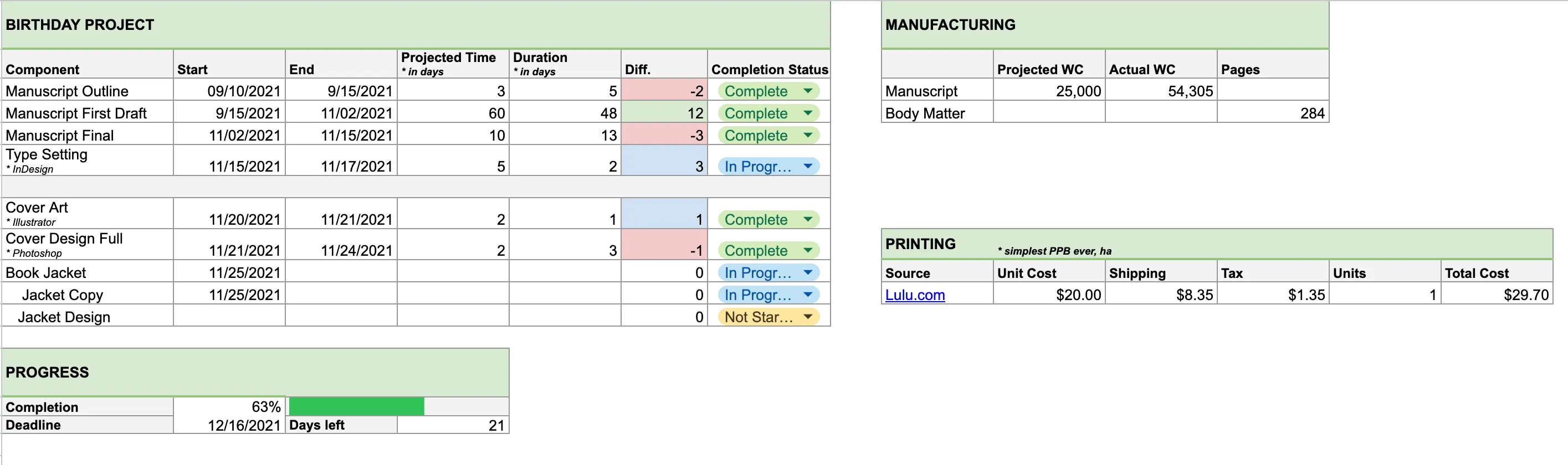
Overall, I learned a lot about the process of manufacturing a book, and gained a lot of unique experience with different tools in the publishing industry, such as InDesign and Illustrator. Additionally, it seemed natural while working on this project to think about the book as a real title and consider how it might be marketed and sold. As such, a lot of this project felt like an exercise in publishing, long before I ever considered publishing as a viable career path.